Last Updated: November 26, 2026
Quick Summary
Kitchen wall tile cost per square metre depends on the tile you choose, the condition of the wall and the tiler’s rate, so there is no single figure that fits every kitchen. Supply is only one line in the budget, as labour, adhesive, trims and preparation often decide the final total.
- Tile suppliers generally group products into budget, mid-range and premium bands, each reflecting material, finish and size.
- Ceramic tiles are lighter and easier to cut, making them a sensible budget choice for kitchen walls.
- Measure each wall section separately in metres, add them together and round up at the end.
- A splashback quote breaks into five lines: tiles, adhesive and grout, trims, preparation and labour.
- Ask each tiler what is included, because a lower quote that excludes preparation is incomplete, not cheaper.
How much does kitchen wall tile cost per square metre?
Kitchen wall tile cost per square metre depends on the tile you choose, the condition of the wall and the tiler’s rate, so there is no single figure that fits every kitchen.
Many homeowners make this same mistake. A homeowner finds a tile they love, multiplies the rate by their wall area, and treats that number as the project cost.
Below, we break the numbers down the way they actually land on a quote, so you can budget with your eyes open rather than guessing.
What the price bands look like
Tile suppliers generally group products into three broad bands. A tile cost comparison covering budget, mid-range and premium options sets out the structure clearly: budget tiles sit at the lower end, mid-range tiles in the middle, and premium tiles at the top. Each band reflects material, finish, size and how closely the tile imitates natural stone.
The practical lesson is simple. Moving up a band multiplies across every square metre you tile, so a splashback that seems affordable per tile can climb quickly once your area is measured properly.
Why supply is only part of the figure
The tile itself is roughly half the story. A tiler charges for laying, and that rate reflects the size of the tile, how many cuts are needed, and how much preparation the wall demands.
Small mosaics take longer than large-format tiles because there are more pieces and more grout lines. A wall with a window, a cooker hood and power outlets needs more cutting than a flat panel.
Budget, mid-range and premium tile bands
Choosing a band is the first real decision, and it shapes everything that follows. Budget tiles suit a straightforward splashback where the tile is a background rather than a feature.
One honest caveat: a higher price does not automatically mean a better tile for your kitchen.
Our wall tiles range lets you browse current products and check specifications directly, which is the only reliable way to map a band to a real tile.
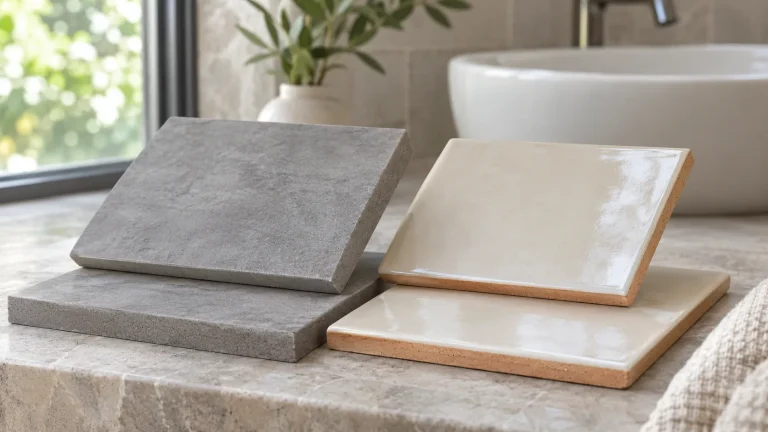
Ceramic vs porcelain wall tiles: which suits a kitchen wall?
For a kitchen wall, ceramic is often the sensible budget choice. It is lighter on the wall and simpler to work with.
The trade-off is cost and cutting. If you are weighing the two, our guide on whether porcelain tile is worth the extra cost over ceramic walks through the durability comparison in detail.
Using a kitchen tile calculator for area and quantity
A kitchen tile calculator is a simple tool that multiplies wall height by wall width to give you square metres. Measure each wall section separately, then add them together.
Work in metres, not millimetres, and round up at the end. Subtract obvious gaps like a full-height window, but do not subtract every small outlet, because the offcuts still cost you.
Once you know your area, tile size becomes the next question. Our guide on what size tiles are best for kitchen walls helps you match a format to your wall dimensions before you finalise a quantity.
Setting a tile wastage allowance
A tile wastage allowance is the extra percentage you add to your measured area to cover cuts, breakages and future repairs.
A flat wall with few cuts needs less spare than a splashback wrapped around a window, a cooker hood and a run of power points.
Ordering exactly your measured area leaves nothing for a miscut, and a discontinued tile may be difficult to match later.
The cost to tile a kitchen splashback, item by item
The cost to tile a kitchen splashback is the sum of five lines: tiles, adhesive and grout, trims and edging, surface preparation, and tiler labour. Each line is separate, and each one moves the total. Most quotes you receive will fold some of these together, which is exactly why it pays to know what sits inside each one before you compare totals.
Tile supply is usually priced per square metre, so your measured area drives this line. Adhesive and grout are modest but real, and they scale with tile size and grout-joint width.
A worked splashback example
Take a hypothetical splashback: 3.6 metres long and 0.6 metres high, giving 2.16 square metres. Add a buffer for cuts and you are ordering around 2.4 square metres. That buffer is not a universal rule; it reflects a run with a range hood and a few power points, which is a common kitchen layout.
Now apply a band. If your chosen tile sits at a given rate per square metre, multiply that rate by 2.4.
Preparation and labour are the lines that swing most. A flat, sound plasterboard wall behind a new splashback keeps preparation small.
The point is not the number. If you plan to do the work yourself, our guide on DIY kitchen splashback tiling tips explains where a clean finish is won or lost.
Watch out: a quote that lists only tiles and labour is not a complete splashback price.
A splashback quote breaks into five separate lines, and each one moves the total.
| Cost line | What it covers | What drives it |
|---|---|---|
| Tiles | Tile supply, priced per square metre | Your measured area |
| Adhesive and grout | Fixing and jointing materials | Tile size and grout-joint width |
| Trims and edging | Finishing exposed edges | Top edge plus vertical returns |
| Surface preparation | Filling, sanding, priming, old tile removal | Condition of the wall |
| Tiler labour | Laying the tiles | Time and difficulty, not area alone |
Labour, preparation and finishing costs that change the total
Labour is where budgets most often drift, and it is the line homeowners understand least. A tiler prices the job on time and difficulty, not just area. Two splashbacks of identical size can carry different labour if one is a flat panel and the other wraps around a window, a range hood and a run of power points.
Regional labour-rate differences
Tiling rates vary between regions, and they vary between tilers in the same suburb. Metro areas with high demand tend to carry higher rates than regional centres, and travel to a site can be priced in. Rather than relying on a national average, ask each tiler for a written quote that separates labour from materials, so you can compare like with like.
Wall preparation and old tile removal
Preparation covers filling cracks, levelling uneven render, and priming. Removing old tiles adds time and waste disposal, and it can damage the substrate beneath, which then needs patching before tiling begins. A wall in good condition keeps this line small; a tired wall can push it up noticeably. Where the wall is in a wet or splash-prone zone, suitability of the substrate and any waterproofing requirement depend on the product, the location and the applicable requirements, so confirm this with your tiler or a qualified professional rather than assuming a standard approach.
Grout, trims and edging
Grout, adhesive and trims are small line items that add up. Trims finish exposed edges cleanly, and a trim in a matching finish lifts the whole job. Grout choice matters too: a contrasting grout highlights a layout, while a matching grout lets the tile read as one surface. These are the details that separate a tidy splashback from one that looks unfinished, and they are easy to overlook when you are comparing tile prices alone.
A checklist for comparing tiler quotes
Comparing quotes properly means matching scope, not just totals. Ask each tiler what is included: preparation, removal, adhesive, trims, and cleanup. A lower quote that excludes preparation is not cheaper, it is incomplete.
- Is preparation and old tile removal included?
- Are adhesive, grout and trims listed separately?
- Is the tile product and size specified in writing?
- Is waste disposal included?
- Is the quote fixed or subject to change?
Bring your shortlist to our Campbelltown showroom for tile-selection advice, and check current prices and specifications on our product pages before you request quotes.
How to compare tiler quotes and choose your tiles
Comparing quotes properly means matching scope, not just totals. Ask each tiler what is included: preparation, removal, adhesive, trims, and cleanup. A lower quote that excludes preparation is not cheaper, it is incomplete.
Then choose your tiles with the same discipline. Our kitchen splashback tile selection tips cover finish, size and layout, and they help you shortlist before you request quotes so every tiler prices the same product.
A short checklist for comparing quotes:
- Is preparation and old tile removal included?
- Are adhesive, grout and trims listed separately?
- Is the tile product and size specified in writing?
- Is waste disposal included?
- Is the quote fixed or subject to change?
Bring your shortlist to our Campbelltown showroom and we will help you check specifications and current pricing on the tiles you are considering.
Tiling a kitchen wall is a budget question and a specification question at once, and the two are hard to separate without help. Bargain Factory Tile Outlet’s Campbelltown showroom offers floor, wall, bathroom, outdoor, subway and mosaic tiles, plus adhesives and tiling accessories at factory-direct prices. You can browse the range online, check current prices and specifications on each product page, and visit us for tile-selection advice before you commit.
Frequently Asked Questions
Does the cost per square metre include installation?
No. Tile prices per square metre cover supply only. Tiling labour, adhesive, grout, trims and any wall preparation are quoted separately by your tiler, so a like-for-like comparison needs both figures. Ask each tiler whether their rate includes adhesive and grout or whether those are added on top, and check whether removal of old tiles is included. Add the supply and installation figures together to see the real total for your kitchen wall.
How much extra tile should I buy for cuts and breakages?
The tile wastage allowance depends on your layout, not a fixed rule. A simple set-out with few cuts needs less spare than a splashback full of powerpoints, windows and corners. Buy a few extra tiles beyond your measured area and keep the leftovers, because matching a tile later can be difficult if the batch changes. Your tiler can advise based on the actual set-out, and your supplier can confirm current stock before you order.
Are porcelain kitchen wall tiles more expensive than ceramic tiles?
Porcelain generally sits above ceramic in the price bands because of how it is made, though the gap varies by range and finish. Ceramic wall tiles are often lighter and easier to cut, which suits many splashbacks. Porcelain can suit areas that need more durability. Compare the specific products rather than the category alone, and check current product pages for prices and specifications before deciding.
How can I compare tile quality when shopping for budget kitchen tiles?
Look beyond the price per square metre. Check the tile’s stated dimensions and whether the range is calibrated for tight joints, inspect a sample for shade variation and surface finish, and confirm the recommended use for walls. Ask about batch consistency and stock levels so you can order enough in one go. A cheaper tile that needs replacing early costs more overall, so weigh durability and availability alongside the headline rate.