

Why Do Tile Faces Matter?
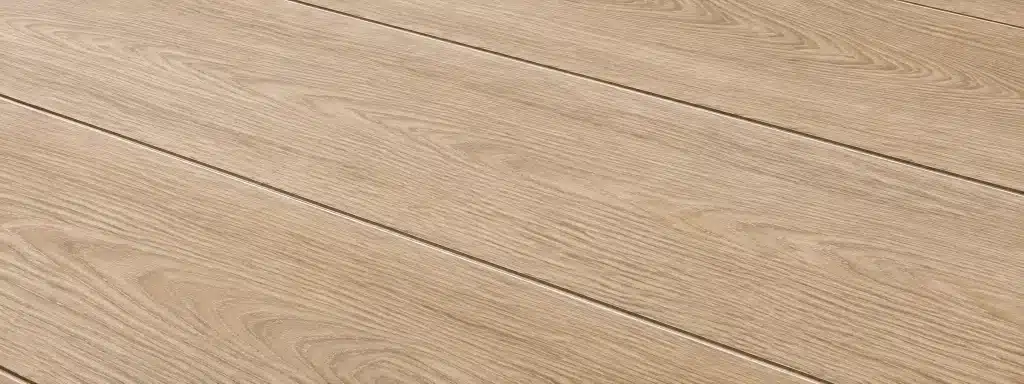
Different printed faces help reduce obvious repetition. Compare several tiles to judge the variation.
Explore colours, patterns and practical advice to help you choose timber-look tiles with confidence.
Shop Timber-Look Tiles →Timber-look tiles bring wood grain and natural character into a tiled surface. This guide helps you compare colours, understand laying patterns and make practical choices about grout, care and where each tile can be used.
The same travertine-look bathroom, with only the timber-look feature wall changed. Which is your style?
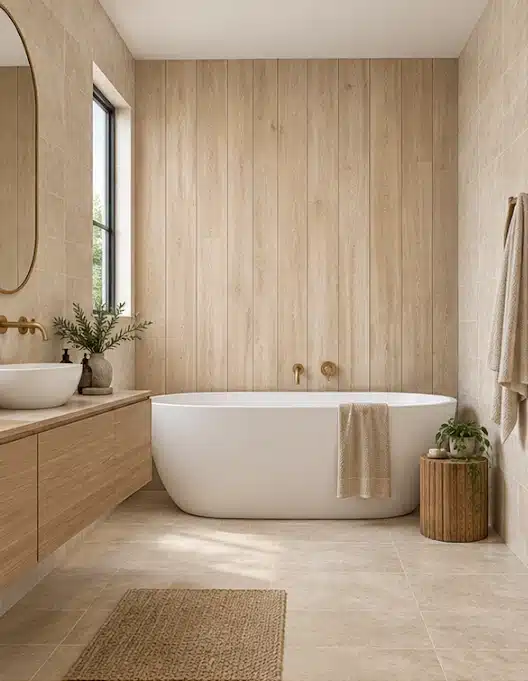
Soft contrast for a calm, open feel.
Pale timber tones blend softly with the travertine look, creating gentle contrast and a calm, open feel.
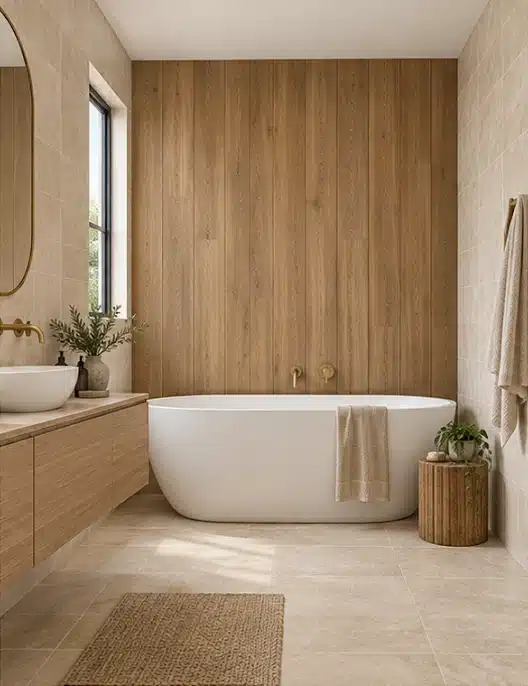
Natural richness and cosy character.
Medium timber tones add natural richness and cosy character while keeping the palette balanced.
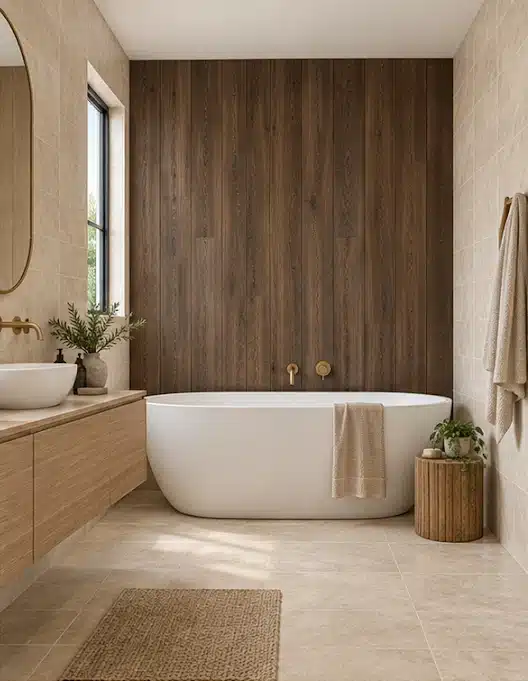
Deeper contrast and a more intimate mood.
Deep timber tones create stronger contrast and a more intimate atmosphere. The pale bath and travertine-look walls stand out against the darker feature.
These are design visualisations. Compare actual tile samples in store for colour and texture; the dark and medium examples are not claims of current product availability.
Different printed faces help reduce obvious repetition. Compare several tiles to judge the variation.
Texture varies by range. Feel the actual samples and compare the finish before choosing.
Realism comes from the combination of grain, colour variation, surface texture and the way the tiles are arranged. Look at several actual pieces together rather than judging the range from one small image.
A tile face is one of the printed designs within a range. Multiple faces help reduce obvious repetition and create a more varied timber effect. Check the face count for the particular tile rather than assuming every range has the same number. Mixing tiles from several boxes and reviewing the layout before fixing helps distribute variation.
Texture varies between ranges. Feel the actual samples and compare the finish before choosing. Surface texture and physical warmth are different qualities: a tile’s timber appearance does not mean it will feel thermally the same as timber flooring.
Varied grain and mid-tone colours can make small amounts of everyday dust less obvious than a very uniform surface. That is a visual effect, not a substitute for cleaning. Compare samples in lighting similar to your room and consider how the grout will look as well.
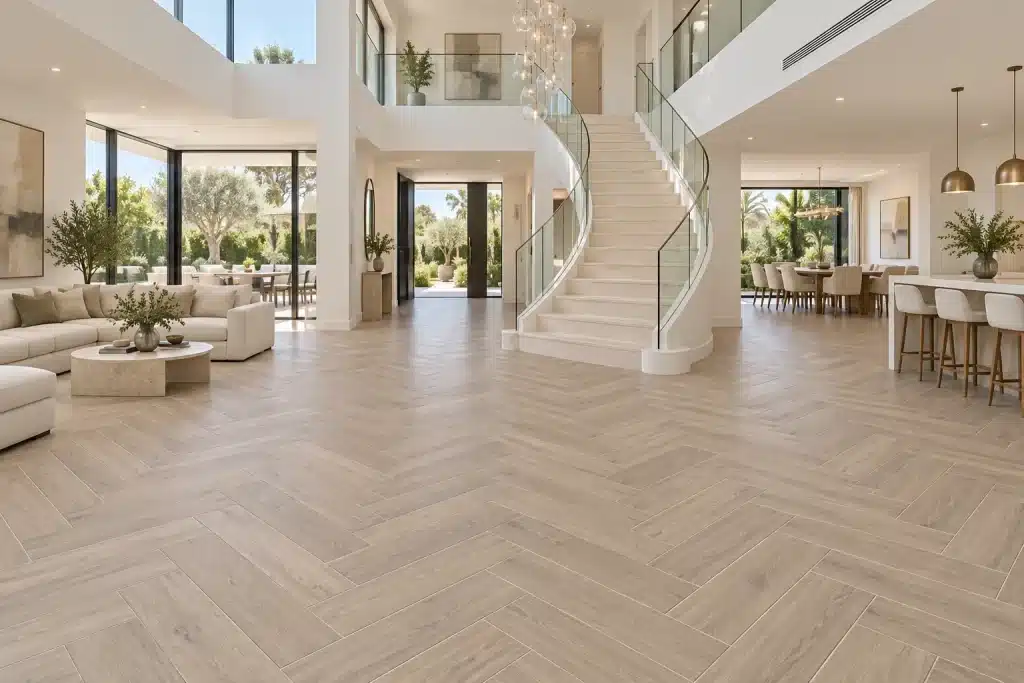
Movement and character for a standout floor.
A quieter pattern with a natural, flowing look.
Ask your tiler to plan the layout and cutting allowance.
Design visualisations. Use actual tile and grout measurements for the set-out.
| Layout | Character | What To Consider |
|---|---|---|
| Herringbone | Movement, detail and a standout floor | Accurate set-out, more cuts and the scale of the pattern in your room |
| Straight lay | A quieter pattern and a natural, flowing appearance | Plank direction, room proportions and the manufacturer’s layout guidance |
Long rectangular planks can create a generous herringbone pattern, as illustrated in our design visual. Confirm the selected tile’s dimensions, tolerances, recommended joints and layout suitability with the supplier and installer. An AI image shows the appearance; it does not verify the installation specification.
No. Herringbone uses rectangular pieces meeting at right angles in an interlocking pattern. Chevron uses angled ends meeting to form a continuous V. Use the correct name and image when discussing your layout with the tiler.
It can, because setting out and cutting the pattern takes additional work. Ask for a quote based on your tile, room and substrate. Compare the complete installation cost as well as the tile price per m2; this hub does not publish unverified Sydney labour rates.
Small deviations at the start can become large alignment errors across the room. Correct them as you go.
These are set-out tips, not a complete installation specification. The substrate, adhesive coverage, joints and selected tile still need the appropriate installation method.
Gary recommends SikaTile®-410 Secure Set for its balance of working time and setting time. Read his full recommendation below.
Match the adhesive to the tile and substrate.
The Adhesive I’d Choose For My Own Home
“For my own home, I’d use SikaTile®-410 Secure Set. It’s a little dearer, but I like the balance: enough working time to position and adjust the tiles carefully, without taking too long to set. That’s particularly useful when getting a herringbone pattern right.”
Gary’s practical recommendation should be matched to the tile, substrate and conditions of the project.
Sika’s product data sheet lists 30 minutes’ open time, up to 30 minutes’ adjustability and grouting after 24 hours under its stated laboratory conditions of 23°C and 50% relative humidity. Site conditions change working and waiting times. Pot life is separately listed as two hours; it is not the same as open time after spreading. Follow the current product instructions.
Start with a grout close to the tile’s background tone, then coordinate the silicone. Compare our colour samples with Gary’s guidance.
Start with a grout close to the tile’s main background tone for a natural, flowing timber look. A contrasting grout makes the pattern more prominent. Compare cured samples against the actual tile rather than relying only on a screen or printed chart.
Coordinate the silicone colour with the grout for a consistent appearance at the joints where a suitable flexible sealant is specified. Colour matching does not determine joint construction: follow the installation requirements for edges, changes of plane and movement joints.
Yes. We have grout colour samples in store, and Gary’s tiling experience to help you compare them with your chosen timber-look tile. Bring the other finishes you are trying to coordinate, or photos of them, to make the discussion more useful.
Glazed porcelain timber-look tiles have a surface that helps resist everyday stains. Remove loose dirt regularly and use a cleaner suitable for the tile and grout, following their care instructions. Attend to spills and remember that grout can need different care from the glazed tile face.
Choose a range approved for your outdoor application and check its slip rating and fixing requirements. A Matt finish alone is not proof of outdoor or wet-slip suitability. Patios, exposed areas and pool surrounds can have different requirements.
Yes, a suitable timber-look tile can bring warmth, texture and cosy elegance to a bathroom feature wall. Pair it with simple complementary tiles so the grain has room to stand out. Confirm the selected tile and installation system suit the wall and any wet-area exposure.
Ask your tiler to calculate the allowance from the room shape, chosen pattern and edge cuts. Herringbone commonly needs more cutting than a straightforward plank layout, but one percentage does not suit every room. Include any spare tiles you want for future repairs, then round the order to full boxes. Do not assume the shop calculator’s standard 10% setting is a confirmed herringbone allowance.
Outdoor-suitable porcelain tiles can be considered as part of a design for patios, verandahs and alfresco areas. Have the builder or certifier confirm that the complete construction meets the property’s Bushfire Attack Level (BAL) requirements. A tiled surface alone does not establish bushfire compliance for the supporting structure or whole home.
Suitability depends on the exact product and complete installation. For unusual heat exposure, verify the tile and fixing system. For motorbikes or other heavy loads, the substrate, tile strength and adhesive coverage matter, as does concentrated pressure from stands. Confirm the intended use before selecting the tile; do not infer a load rating from the timber-look appearance.
The tiles are hard-wearing and resistant to everyday stains, rather than chip-proof or stain-proof. Sharp impacts can chip tile edges or surfaces, and resistance varies with the product and exposure. A protective glaze does not make every chemical or impact harmless.
Browse our Timber-Look Tiles landing page for the current range, or visit Bargain Factory Tile Outlet in Campbelltown for samples and advice. Product pages show current prices, availability and pickup details. Delivery To You Available.
See an in-store AI visual of your room, compare tile and grout samples, and get experienced advice.
Bring photos of your room into our store and we can create an AI visual showing your selected timber-look tiles in your space. Compare a herringbone floor, a straight-laid pattern or a bathroom feature wall before settling on the design.
Then feel the actual tile samples, compare grout colours and discuss the practical details with Gary. AI visuals illustrate the design; samples help you judge the real colour and texture.
Find Complementary Tiles For The Rest Of Your Home.


