Last Updated: October 18, 2026
How to Choose the Right Size for Kitchen Wall Tiles
There is no single answer to what size tiles are best for kitchen walls. The right choice depends on your wall dimensions, the splashback area you need to cover, and the look you want. At Bargain Factory Tile Outlet, we help customers work through that decision every day in our Campbelltown showroom.
Start with the wall, not the tile. A splashback that runs between a worktop and upper cabinets has a fixed height. That height often decides the tile size for you. Measure the gap first, then choose a tile that fits it cleanly.
Start With the Wall, Not the Tile
Measure the width and height of the wall area you plan to tile. Note where powerpoints, rangehoods and windows sit. A wall with many cut-outs suits a smaller tile, because you waste less on cuts. A long, clear run suits a larger format.
Match the Tile to the Job It Has to Do
Ask what the wall needs to do. A splashback behind a cooktop needs easy cleaning, so fewer grout lines help. A feature wall above a worktop can carry more pattern and texture. Tiles.co.nz’s guide to choosing tile size notes that large tiles create a clean, uninterrupted look while smaller tiles add texture and detail.
Kitchen Splashback Tile Sizes: What Fits Where
Kitchen splashback tile sizes range from small mosaics up to large-format slabs. Each fits a different space. A standard gap between worktop and upper cabinets is often around 600 mm, so a tile that divides neatly into that height reduces cutting.
Common options include:
- Mosaics: small sheets, good for tight or curved areas
- Subway tiles: classic rectangular format, easy to lay in a running bond
- Medium squares: simple and forgiving on walls with cut-outs
- Large-format tiles: fewer grout lines, a more seamless look
Bedrosians’ 2026 kitchen tile trends guide describes porcelain slabs available in formats up to 120 × 60 cm that can cover a splashback or a full wall.
Large or Small Kitchen Wall Tiles: Weighing the Trade-offs
Large or small kitchen wall tiles each have real trade-offs. Bigger tiles mean fewer grout lines to clean and a calmer surface. Smaller tiles handle awkward spaces better and add visual interest. Neither is automatically correct.
When Fewer Grout Lines Help
Grout is where grease and stains collect. A larger tile cuts the amount of grout across a splashback, which makes wiping down faster. This matters most directly behind a cooktop. One caution: large tiles need a flat wall, because any bow in the plaster shows up across a wide surface.
When Detail and Texture Win
Smaller tiles shine on walls with windows, powerpoints or uneven edges. They let you follow the shape of the space. A common mistake is choosing a large tile for a wall full of cut-outs, then paying for wasted material and extra cutting time.
A small kitchen does not always need small tiles. Fewer grout lines can make a compact space feel less busy, which is the opposite of the usual advice.
Subway Tile Sizes for Kitchen Splashbacks
Subway tile sizes for kitchen splashbacks are usually rectangular, and the proportions matter more than the exact dimensions. The classic look is a rectangle laid in a running bond, where each row is offset by half a tile. Wider or narrower formats change the feel.
A few practical points:
- A standard rectangular subway tile suits most splashback heights
- Larger subway formats mean fewer grout lines
- Stacked layouts look more modern; offset layouts look more traditional
- Check box coverage before you order, because sizes vary between ranges
We stock subway tiles in our Campbelltown showroom, and you can compare formats side by side before deciding. Current sizes and prices are listed on our product pages.
How to Calculate Tiles for a Kitchen Splashback
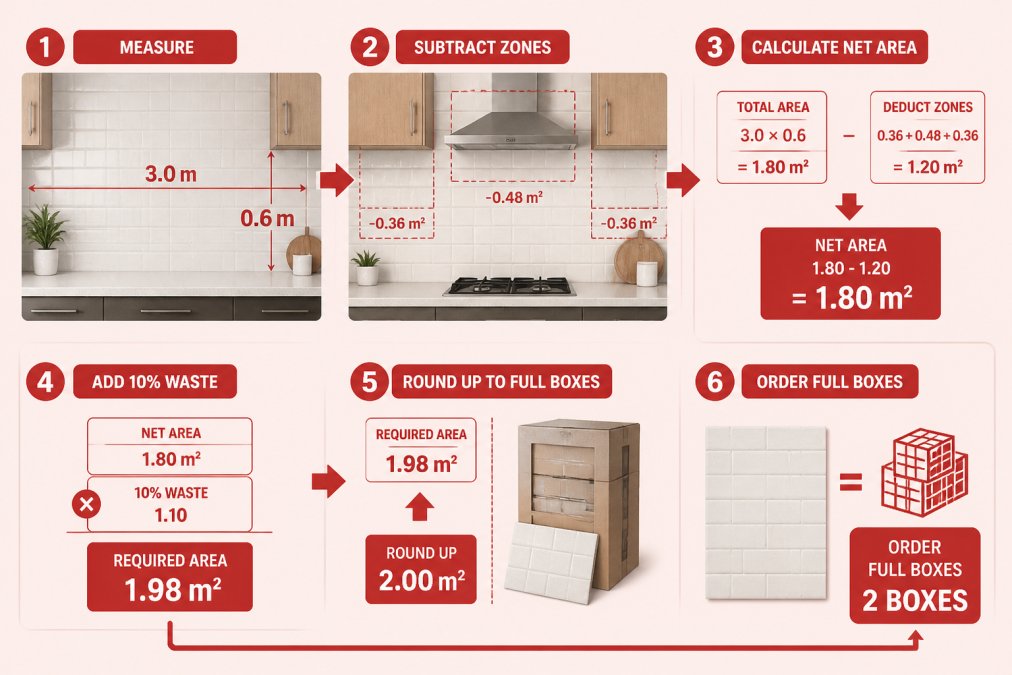
To calculate tiles for a kitchen splashback, measure the width and height in metres, multiply them to get square metres, then add a waste allowance. The allowance depends on your layout and how many cuts you face, not a fixed rule.
Worked example with assumed numbers:
- Wall width: 3.0 m
- Height: 0.6 m
- Area: 3.0 × 0.6 = 1.8 m²
- Waste allowance for a simple layout: add 10%, giving 1.98 m²
- Round up to full boxes based on the coverage printed on the box
A wall with many cut-outs may need a higher allowance. Check the box coverage for your chosen tile, because it changes with size.
Common Mistakes When Sizing Kitchen Wall Tiles
The most common mistakes when sizing kitchen wall tiles come from skipping the measuring stage. Here is what we see most often:
- Choosing the tile before measuring the wall gap
- Forgetting to allow for cuts around powerpoints and rangehoods
- Ordering too little and running short mid-project
- Assuming a large tile will suit an uneven wall
- Mixing up natural stone and porcelain look-alikes when comparing finishes
On that last point: natural stone and porcelain can look similar, but they behave differently. Check the product specification for the material you are buying, and ask about sealing and maintenance before you commit.
Ordering tiles in one batch matters. If you run short and reorder later, the new tiles may come from a different production run with a slightly different shade.
Conclusion
Choosing a tile size comes down to your wall, your layout and how much cleaning you want to do. Measure first, then match the format to the space.
If you would like to compare sizes in person, visit our Campbelltown showroom at 20A Blaxland Road. We can help you weigh up large and small formats, check subway options and work through your quantities. Get directions and bring your measurements with you.
Frequently Asked Questions
Are large or small tiles better for a kitchen splashback?
Neither is universally better; it depends on the look you want and the wall you have. Large-format tiles give a cleaner, more uninterrupted surface with fewer grout lines, which suits modern kitchens and walls that are reasonably flat. Smaller tiles add texture and detail and can work around awkward shapes such as window reveals and power points. Check that the tile is rated for wall use, and ask about the substrate and adhesive before committing to a very large format.
What size tiles make a small kitchen look bigger?
Large tiles can make a small kitchen feel less cluttered because there are fewer grout lines breaking up the wall. That said, tile size should not be chosen by room size alone. A smaller tile in a light colour with a matching grout can also keep a wall looking calm. The bigger factors are usually colour, grout choice and how the layout handles corners and cabinetry, so view samples against your actual wall before deciding.
Are 300 x 600 mm tiles suitable for kitchen walls?
A 300 x 600 mm tile is a common mid-format choice for kitchen walls and splashbacks. It covers area quickly while still allowing reasonable cuts around power points and rangehoods. Suitability depends on the individual product being rated for wall use and on your wall being flat enough for the format. Confirm the specification on the current product page, and speak to your tiler about substrate preparation before ordering.
How do you calculate tiles for a kitchen splashback?
Measure the splashback width and height in metres and multiply them to get square metres. Subtract areas you are not tiling, such as behind a freestanding rangehood or above a tall cabinet. Add a waste allowance for cuts, corners and breakages, then divide by the square metres per box and round up. Waste depends on your layout and how many cuts are needed, so confirm the allowance with your tiler before ordering.