
Last Updated: November 10, 2026
Quick Summary
The best high-traffic floor tiles are dense, hard-wearing porcelain with a matt or textured finish and a PEI rating of 4 or 5. Density, wear rating and surface grip decide whether a busy floor still looks good after years of use. Avoid polished tiles in hallways, as they show marks and become slippery when wet.
- Porcelain is fired at higher temperatures than ceramic, making it denser and less porous.
- The PEI rating scales surface hardness from 1 to 5, with PEI 4 and 5 suited to heavy use.
- Ceramic suits bedrooms and low-traffic rooms but wears faster under constant abrasion in hallways.
- A darker, fine grout line hides dirt in a busy hall far better than bright white grout.
- For a 20 m² hallway with 10 per cent waste, order roughly 22 m² of tile.
What Makes a Floor Tile Suitable for High-Traffic Areas
The best high-traffic floor tiles are dense, hard-wearing porcelain with a matt or textured finish and a PEI rating of 4 or 5. Those three qualities, density, wear rating and surface grip, decide whether a floor still looks good after a decade of shoes, chairs and dropped keys.
At Bargain Factory Tile Outlet, we field this question constantly from renovators in Macarthur and Western Sydney. The honest answer is that most failures in busy floors come down to the wrong tile for the room, not a bad tile.
High-traffic floor tiles are tiles specified to withstand constant footfall, abrasion and cleaning without visible wear. The term covers entrance halls, kitchens, laundries, open-plan living zones and any commercial space where people move through all day.
Density, PEI Rating and Surface Finish
Density is the foundation. Porcelain is fired at higher temperatures than ceramic, which makes it denser, less porous and more resistant to moisture and staining.
The PEI rating, set by the Porcelain Enamel Institute, scales surface hardness from 1 to 5. PEI 4 suits residential areas with heavy use; PEI 5 handles commercial traffic and abrasive grit. Porcelain Enamel Institute guidance on tile wear ratings
Surface finish matters as much as hardness. Polished tiles show scratches and footprints; matt and textured finishes hide both and grip better underfoot.
Porcelain Floor Tiles: The Default Choice for Busy Floors
Porcelain floor tiles are the standard recommendation for heavy footfall, and for good reason. They combine high density, strong scratch resistance and low moisture absorption in one product.
For hallways, kitchens and open-plan living, a through-bodied or full-bodied porcelain holds its colour if the surface ever chips. Glazed porcelain gives you more pattern choice, from stone-look to concrete-look, while keeping the durable porcelain base.
Large-format porcelain is a practical trend for busy zones because fewer grout lines mean less to clean and fewer joints to trap dirt. It does need a flatter subfloor, which we cover below.
Where porcelain falls short: it is hard and cold underfoot, and it is unforgiving if a heavy object lands on it. For a lounge room where comfort matters more than wear, that trade-off is worth weighing honestly.
Ceramic Floor Tiles: Where They Work and Where They Don’t
Ceramic floor tiles work well in low-traffic rooms such as bedrooms, formal living areas and upstairs landings. They are lighter, easier to cut and often less expensive than porcelain.
They do not belong in a busy entrance hall. Ceramic is fired at lower temperatures, so it is more porous and its glaze wears faster under constant abrasion. A ceramic tile in a hallway with grit underfoot will dull and scratch long before a porcelain equivalent.
If the budget is tight and the room is quiet, ceramic is a sensible choice. If the room sees constant traffic, put the money into porcelain.
Natural Stone, Timber, Vinyl and Laminate Compared
Tile is not the only option for a busy floor, and the honest comparison is about how each material fails, not just how hard it is. Every flooring type has a wear mechanism, and knowing that mechanism tells you whether it suits your hallway, kitchen or living zone.
Natural stone such as travertine, slate and granite handles foot traffic well because it is solid through its depth, so surface wear exposes more of the same material rather than a thin glaze. The trade-off is maintenance and variability.
Timber feels warm and quiet but dents, scratches and moves with moisture. In a hallway with grit underfoot, a soft timber surface will show traffic lanes far sooner than tile. Engineered and solid timber can be refinished, which extends life, but refinishing is periodic work rather than a one-off.
Vinyl planks and hybrid flooring have improved markedly, with thicker wear layers and water-resistant cores. They suit busy family homes where comfort, warmth and quiet matter more than maximum scratch resistance. The wear layer thickness is the number that matters; a thin wear layer dulls quickly in an entry hall.
Laminate is the most scratch-prone of the group and dislikes standing water, particularly at joints. It suits bedrooms and studies better than wet or gritty zones.
| Flooring | Wear mechanism | Moisture tolerance | Maintenance pattern | Best suited to |
|---|---|---|---|---|
| Porcelain tile | Surface abrasion; glaze or body wears slowly | High | Damp mop; grout attention | Hallways, kitchens, laundries |
| Ceramic tile | Glaze wears faster under grit | Moderate | Damp mop | Bedrooms, low-traffic rooms |
| Natural stone | Surface wears but stays stone; sealing needed | Varies by stone | Periodic sealing and cleaning | Feature floors, entries, outdoors |
| Timber | Dents, scratches, moisture movement | Low | Periodic refinishing | Living rooms, bedrooms |
| Vinyl and hybrid | Wear layer abrades; core resists water | High | Damp mop | Family homes, wet zones |
| Laminate | Surface scratches; joints swell if wet | Low | Damp mop, avoid wet | Bedrooms, studies |
A useful way to decide is to ask what the floor will meet most often. Grit and wet shoes favour porcelain or stone. Dropped items and comfort favour vinyl or hybrid. Direct sun and moisture swing the decision towards tile and stone over timber and laminate.
If you love timber underfoot but need tile durability, timber-look porcelain tiles give you the grain without the refinishing. For genuine stone, browse our natural stone range to compare travertine, slate and granite options in person.
Floor Tiles for Hallways and Entryways
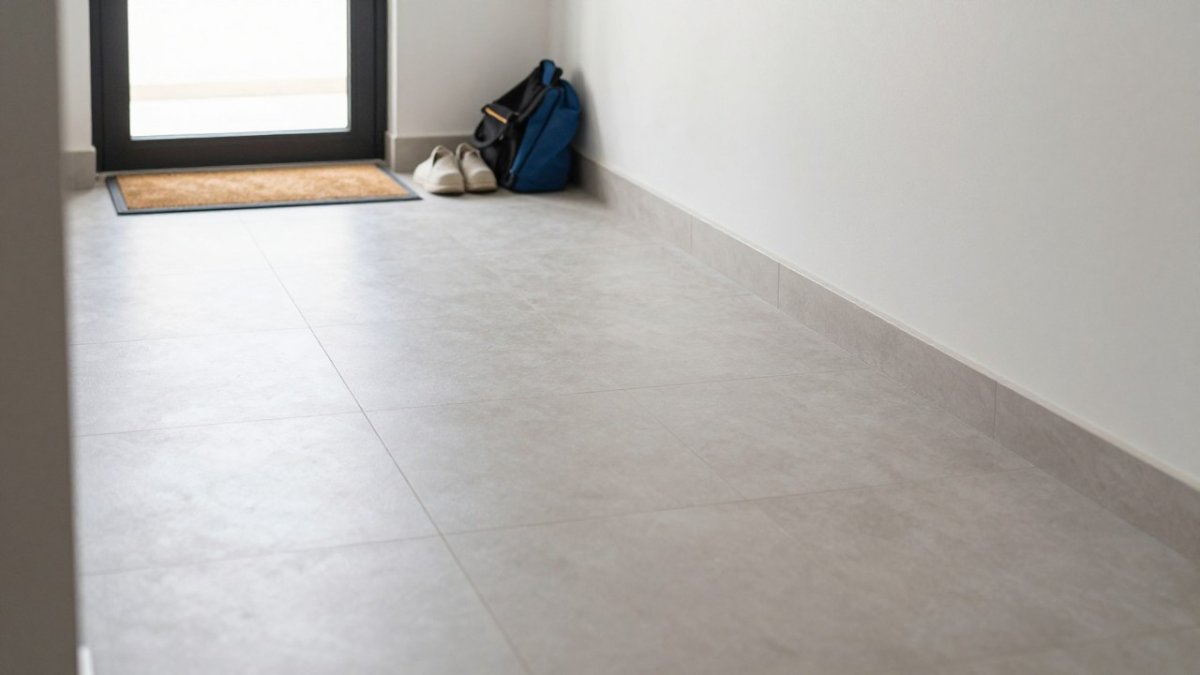
Floor tiles for hallways and entryways need to survive grit, wet shoes and constant movement, so choose a dense porcelain with a matt finish and a PEI 4 or 5 rating. Avoid polished surfaces here; they show every mark and become slippery when wet.
Entryways are where dirt arrives, so a slightly textured surface helps trap grit rather than letting it abrade the tile. Choose a mid-tone or patterned tile over plain white, which shows scuffs quickly.
Grout choice matters as much as the tile. A darker, fine grout line hides dirt in a busy hall far better than bright white grout.
Slip-Resistant Floor Tiles and Wet-Area Safety
Slip-resistant floor tiles reduce the risk of falls, but no single rating suits every situation. Suitability depends on the tile, the location, how wet the area gets and the requirements that apply to your project.
Slip ratings describe how a tile performs when wet, and a tiled bathroom floor, an outdoor terrace and a covered entry each call for different levels of grip. We do not give blanket compliance advice, because the right answer depends on your specific site and the standards that apply. Speak to a qualified tiler or building professional before specifying wet areas.
To compare grip levels, browse our P4 slip rating tiles and P5 slip rating tiles. For outdoor areas, our guide to non-slip tiles for outdoors walks through the practical buying decisions.
Grout, Subfloor and Installation Quality
Even the best tile fails on a poor subfloor. Movement, lippage and hollow-sounding tiles almost always trace back to preparation, not the tile itself. This is the part of the job most homeowners underestimate, and it is where the difference between a floor that lasts and one that cracks shows up.
Subfloor condition and flatness. Tile is rigid, so it does not flex with the floor beneath it. A substrate that deflects, is uneven or is contaminated will telegraph through as cracked tiles or loose edges.
Adhesive and bedding. The adhesive has to suit the tile and the substrate. Porcelain is dense and absorbs very little water, so it typically needs an adhesive formulated for low-absorption tiles; natural stone may need a different product again. Poor coverage under a tile leaves voids, and a void is where a hollow sound and a future crack begin.
Grout choice and joint width. Grout is not just cosmetic. Narrow joints suit rectified porcelain and give a cleaner line, but they leave less room to accommodate slight tile variation. Wider joints forgive small differences and can grip better underfoot.
Movement joints. Tiled floors expand and contract, and large areas or floors over different substrates need movement joints at the right intervals. Your tiler should specify these.
Repairability. Keep spare tiles from the same batch, because matching a discontinued tile later is difficult. Large-format tiles look clean with fewer grout lines, but replacing one is more involved and more visible than swapping a small tile. If repairability matters, a smaller format with more joints can be the more practical choice.
Watch out: buying tile before the tiler has seen the subfloor is a common and expensive mistake. Confirm the substrate first, then choose the tile and the adhesive system together.
A worked example makes the point. For a 20 m² hallway, assuming a waste allowance of 10 per cent for a straightforward layout, you would order roughly 22 m² of tile; a diagonal or herringbone layout, or a room with many cuts, usually needs more.
Choosing Tiles at Our Campbelltown Showroom
Screens distort colour and texture, which is why seeing a tile in person matters before you commit to a whole floor. Our 1,000 m² showroom at Campbelltown holds floor, wall, bathroom, outdoor, subway and mosaic tiles, plus adhesives and tiling accessories, so you can compare finishes side by side.
Bring your room dimensions and a photo of the space. Our staff can help you weigh porcelain against ceramic and matte against polished, and talk through maintenance. Prices, specifications and availability are listed on our current product pages.
Choosing a floor for a busy home comes down to matching density, wear rating and grip to how the room is actually used. Bargain Factory Tile Outlet stocks dense porcelain, natural stone and practical accessories, offers factory-direct pricing across its range, and gives in-store advice so you can compare tiles before you buy. Get started with Bargain Factory Tile Outlet and choose a floor built for the traffic it will see.
Frequently Asked Questions
Are porcelain tiles better than ceramic tiles for busy floors?
For most busy floors, porcelain is the stronger choice. Porcelain floor tiles are denser and fired at higher temperatures than ceramic, so they handle heavy footfall, moisture and scratching better. Industry guidance recommends tiles rated PEI 4 or 5 for areas with constant traffic. Ceramic can still suit lighter-use rooms, but check the wear rating before committing. Bring your room details to our Campbelltown showroom and we can point you to suitable options.
What tile finish is best for a busy hallway?
A matt or textured finish usually works best in hallways. Polished tiles show dust, scuffs and footprints more readily, and smooth surfaces can be slippery when wet. Matte porcelain floor tiles for hallways hide marks better and offer more grip underfoot. Suitability still depends on the specific product and where it is laid, so check the manufacturer’s slip information and ask a qualified professional about wet areas.
Are natural stone tiles suitable for high-traffic floors?
Natural stone such as granite, slate and travertine can work in busy areas, but it needs more care than porcelain. Stone is porous unless sealed, so it can stain and needs periodic resealing. Granite and slate are generally harder-wearing than travertine. If you want the stone look with less maintenance, porcelain look-alikes are an option, though they are not real stone. Ask us to explain the difference before you buy.
How do you maintain floor tiles in high-traffic areas?
Sweep or vacuum regularly to remove grit that scratches surfaces, and mop with a pH-neutral cleaner suitable for the tile. Avoid harsh acidic cleaners on stone and cement-based grout. Keep entrance mats at doorways to catch dirt. Check grout lines periodically and reseal grout where the manufacturer recommends it. For slip-resistant floor tiles, clean with products that do not leave a slippery film, and follow the manufacturer’s care instructions.