Last Updated: November 2, 2026
Quick Summary
The affordable modern bathroom tile trends for 2026 are large-format porcelain, stone-look finishes and warm earthy colours such as greige, terracotta and mossy green. Spend your budget on format and finish rather than rare materials, and save on walls while investing in floors and showers.
- A 600 x 600 mm tile covers four times the area of a 300 x 300 mm tile.
- Porcelain is fired at higher temperatures and has very low water absorption compared with ceramic.
- Spend on the floor and shower, save on dry vanity and upper walls.
- Match grout colour closely to the tile to make a compact bathroom feel larger.
- Centre the tile layout to push narrow cuts to less visible edges.
Which 2026 Bathroom Tile Trends Fit a Tight Budget
The cheapest way to get a modern bathroom in 2026 is to spend your money on format and finish, not on rarity. Large-format porcelain, stone-look tiles and warm earthy colours deliver the current look without the price tag of natural stone or hand-made product.
Trend coverage for 2026 points in a consistent direction. TileClub’s 2026 bathroom trend report names large-format tile as the defining look of the year, noting that fewer grout lines create a cleaner, more expansive feel. Cotto d’Este’s nine bathroom tile trends for 2026 adds travertine effects, a return to natural materials and porcelain stoneware to the list.
Here is the part most trend articles skip: almost every one of those looks exists in a budget-friendly porcelain version. You are choosing a surface, not a quarry.
Below, we break down which trends are worth your money, which are worth skipping, and how to plan quantities so you do not over-order. For a central hub of bathroom tile ideas and inspiration, including stone-look styles and expert buying advice, explore our dedicated guide.
Large-Format Tiles and Fewer Grout Lines
Large-format tiles can be good value in a bathroom because fewer grout joints mean less grout to buy and a surface that is generally quicker to clean.
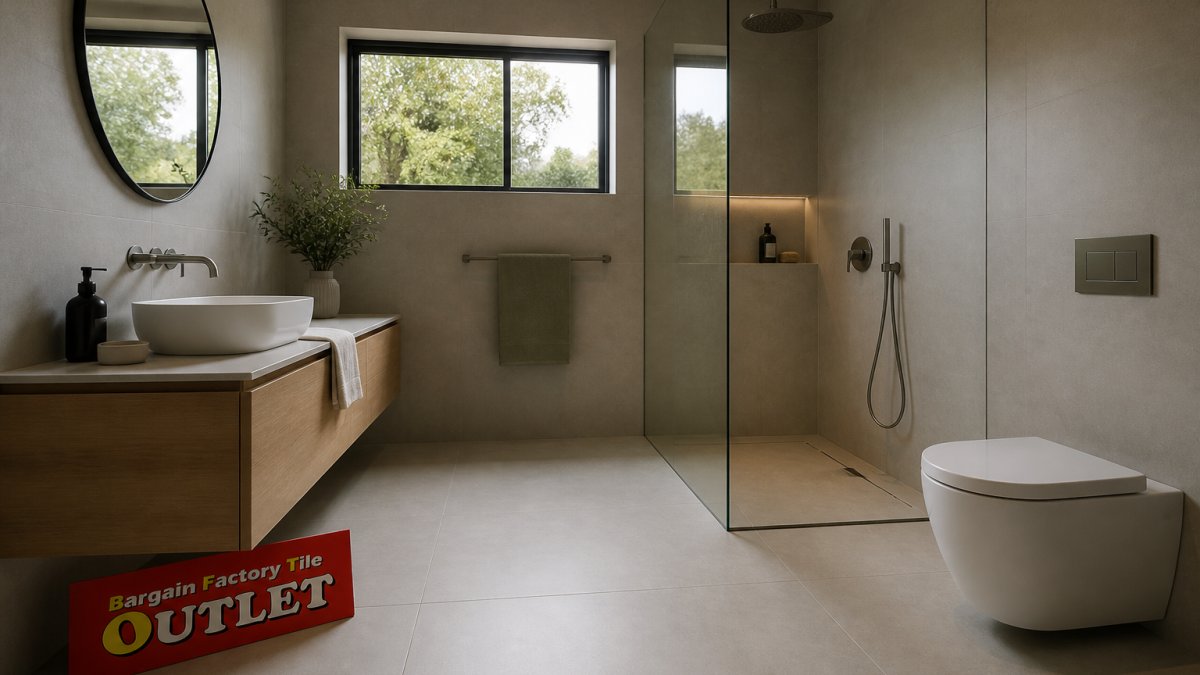
The trade-off is prep. Large tiles show up a substandard wall or floor, so the substrate needs to be flat before laying starts.
If you are weighing formats and finishes, you can browse the large format tile range to see what is available before you decide.
Stone Looks: Marble, Travertine and Limestone Effects
Stone-look porcelain is a common alternative to natural stone. Real marble, travertine and limestone are quarried materials with natural variation and, being porous, generally need sealing.
That distinction matters. Natural stone is a quarried product with natural variation from tile to tile. Porcelain is a manufactured tile printed and textured to resemble stone.
Travertine effects are having a moment in 2026, and the look works well in warm, earthy schemes. You can compare travertine tiles and stone-look options to see real stone alongside porcelain versions side by side.
Colour and Texture Trends: Greige, Terracotta and Mossy Green
Warm neutrals are replacing cool grey as the default bathroom palette. Greige sits between grey and beige and hides water marks better than pure white.
Texture is doing more work than pattern this year. Integrating these tactile surfaces into your space creates a cohesive foundation for the broader aesthetic home decor movements shaping interiors throughout the coming year.
A practical rule: spend on the floor and the shower, save on the walls. Wall tiles are easier and cheaper to change later.
How to Choose Bathroom Floor Tiles That Last
Choosing bathroom floor tiles comes down to three things: slip resistance, water absorption and how the tile handles traffic. Porcelain with a matt or textured finish is a common choice for bathroom floors, as porcelain is generally low in water absorption. Confirm the suitability of any specific tile with the manufacturer’s specification.
Here is how we would shortlist:
- Check the slip rating for the specific location, not the whole room
- Choose porcelain over ceramic for floors that see heavy traffic
- Pick a matte or textured finish over polished on wet areas
If budget is the priority, a related guide on affordable floor tiles for home renovation goes deeper on durable, low-cost options.
Porcelain vs Ceramic Bathroom Tiles Explained
Porcelain and ceramic are both clay-based tiles, but they are not interchangeable once you factor in where the tile is going and what it will cost you over the life of the bathroom. Porcelain is fired at higher temperatures from a denser body, which gives it very low water absorption and high mechanical strength.
The table below is the short version. The paragraphs after it are where the budget decision actually gets made.
| Feature | Porcelain | Ceramic |
|---|---|---|
| Water absorption | Very low | Higher |
| Durability | High, suits floors and wet areas | Moderate, suits walls |
| Cutting | Harder, needs a diamond blade | Easier to cut |
| Best for | Floors, wet areas, outdoor | Wall tiles, splashbacks |
| Relative cost | Generally higher per m² | Generally lower per m² |
Where the budget actually goes
The sticker price per square metre is only one line in the quote. The installed cost of a tile is driven by four things:
- Tile price per m², porcelain usually costs more than ceramic of the same size.
- Cutting and labour, porcelain is harder and slower to cut, so a tiler may charge more labour for intricate layouts in porcelain than in ceramic.
- Substrate preparation, large-format porcelain demands a flatter substrate, which can add preparation cost.
That last point is the one budget shoppers most often miss. Saving a small amount per square metre on a ceramic floor, then replacing it in a few years, is usually a false economy. On walls, where there is no foot traffic and no standing water, ceramic often does the job perfectly well and the saving is real.
A practical split for a budget bathroom
One approach for a tight budget is to spend on the surfaces that are hardest to change and save on the ones that are easiest:
- Floor: porcelain, matte or textured finish.
- Shower walls and floor: porcelain, confirmed by the manufacturer as suitable for wet areas.
- Dry vanity and upper walls: ceramic or porcelain, whichever suits the look and the budget.
This split keeps the expensive, hard-wearing product where it is doing structural work and puts the cheaper product where it is purely decorative.
What to check before you commit
- Confirm the tile is rated by the manufacturer for the location you are using it in, floors, walls, showers and outdoor areas have different demands.
- Ask your tiler whether the substrate needs levelling before large-format porcelain goes down.
- Check the batch and shade on the product page before ordering, and order spares from the same batch where possible.
- Refer to the current product page for price and specification rather than relying on a general guide.
If you are still deciding between formats, you can browse the porcelain tile range and compare specifications on each product page before you shortlist.
Slip Resistance Ratings for Bathroom Tiles
Slip resistance ratings tell you how much grip a tile offers when wet.
Suitability depends on the product, the location and the requirements that apply to your project. A tile that suits a shower floor may be unnecessary on a dry vanity wall.
You can browse tiles with a P3 slip rating to shortlist options, then confirm the rating on the product page before ordering.
Calculating Tile Quantities for Bathrooms
Most trend articles stop at the look. The part that decides whether a budget bathroom stays on budget is the quantity calculation, because over-ordering wastes money and under-ordering risks a second delivery from a different batch. This section covers the calculation, the waste allowance and the layout decisions that reduce offcuts.
The basic calculation
Measure each surface in square metres (length × height or length × width), add the surfaces together, then divide by the coverage per box stated on the product page.
Worked example, a hypothetical bathroom floor of 2 m × 2.4 m:
- Floor area: 2 × 2.4 = 4.8 m²
- Box coverage (example only): 1.2 m² per box
- Base boxes: 4.8 ÷ 1.2 = 4 boxes
Four boxes covers the floor with no cuts. Now add waste for cuts around the toilet, shower, doorway and any pipework. The allowance is not a universal rule, it depends on the layout, the tile size and how many cuts fall on a visible edge. A simple square layout in a rectangular room wastes less than a diagonal or herringbone pattern, and a small tile wastes less per cut than a large-format tile where a single cut can write off a large piece.
The allowance depends on the layout. Simpler layouts generally need less allowance than diagonal, herringbone or rooms with many obstructions. Ask your tiler what allowance they want for your specific layout rather than applying a fixed percentage.
Layout decisions that reduce offcuts
- Match tile size to room dimensions. A tile that divides evenly into the room width produces fewer narrow cuts than one that leaves a thin sliver at each wall.
- Centre the layout. Centring the tile grid on the room, rather than starting from one wall, usually pushes the narrow cuts to the edges where they are less visible and easier to hide under skirting or trim.
- Plan the shower and niche first. These are the areas with the most cuts, so decide the tile and layout there before you order the rest of the room.
- Keep a spare box. Order one extra box where the budget allows and store it for future repairs. A tile from a later batch may not match.
Grout colour and small-space planning
Grout colour changes how a room reads. A grout matched closely to the tile makes the surface look larger and more continuous, which helps a compact bathroom feel less busy. A contrasting grout emphasises the tile pattern and the grid, which suits a feature wall but can make a small room feel smaller. On the floor, a mid-tone grout hides marks better than pure white.
Before you order
- Confirm the current coverage per box and the batch on the product page, do not rely on a guide figure.
- Check availability before you commit to a layout that depends on a specific tile size.
- Keep the calculation and the layout plan with your quote so your tiler can check it against the actual room.
If you are working to a tight budget across the whole renovation, a related guide on affordable floor tiles for home renovation goes deeper on durable, low-cost options.
Next Steps for Your Bathroom Project
The trends worth your budget in 2026 are the ones that reduce cost and upkeep: large-format porcelain, stone-look finishes and warm neutral colours.
At Bargain Factory Tile Outlet, our 1,000 m² Campbelltown showroom stocks floor, wall, bathroom, outdoor, subway and mosaic tiles, porcelain pavers, travertine, adhesives and tiling accessories.
Get started with Bargain Factory Tile Outlet and choose tiles that suit your bathroom, your budget and your layout.
Frequently Asked Questions
What are the most popular bathroom tile colours for 2026?
Warm neutrals and earthy tones are a common direction in current bathroom design: greige, mocha, clay and terracotta, with mossy green and soft blue used as accents. Stone-inspired looks in travertine and marble effects remain common. These are design directions rather than rules, and availability varies by range. A neutral base tile with one accent colour is usually easier to live with long term and simpler to match if you need extra tiles later.
How can I achieve a modern bathroom look on a budget?
Spend on the tiles you see and touch most, and use simpler tiles where they are less visible. A large-format floor tile reduces grout lines and can make a small bathroom feel bigger. Porcelain look-alikes are a manufactured alternative to natural stone, and porcelain is generally not sealed as natural stone often is. Keep the layout simple, avoid excessive cuts, and check current product pages for pricing before you commit to a scheme.
Are large-format tiles still trending for bathrooms in 2026?
Yes. Large-format tiles with fewer grout joints are a common design direction for modern bathrooms, and they can create a cleaner, more expansive look. They can also mean less grout to clean. Check that your substrate is suitable and that the format suits the room size, and confirm handling and installation requirements with your tiler before ordering.
What is the difference between porcelain and ceramic bathroom tiles?
Porcelain is fired at higher temperatures and is generally denser and less water-absorbent than ceramic, which makes it a common choice for bathroom floors and wet areas. Ceramic is often lighter and easier to cut, and can suit wall applications. Suitability still depends on the specific product, its rating and where it will be installed. Ask for the manufacturer’s specifications for the tile you are considering rather than assuming.