Last Updated: October 14, 2026
What to Compare in a Tile Showroom in Campbelltown
Choosing a tile showroom in Campbelltown comes down to four things: how much of the range you can actually see, whether the advice is practical, whether stock is consistent, and whether specifications are published where you can check them. Everything else is marketing.
At Bargain Factory Tile Outlet, our 1,000 m² showroom at 20A Blaxland Road was built around that first point. Tiles look different under showroom lighting than they do in a bathroom, and a screen can only tell you so much. Below, we break down what separates a showroom worth the drive from one that just holds stock.
Why the Showroom Still Matters for Tile Selection
Online tile shopping is convenient, but a photograph flattens colour, hides texture and rarely shows true scale. A 600 x 600 mm tile photographed straight-on can look identical to a 300 x 600 mm one until you stand next to it.
Seeing tiles in person lets you check the surface finish, the shade variation between boxes, and how a gloss or matt face reads against natural light. It also lets you put two tiles side by side, which is the only reliable way to judge whether a warm grey and a cool grey actually work together.
That is the case for visiting before you order, whether you buy from us or elsewhere.
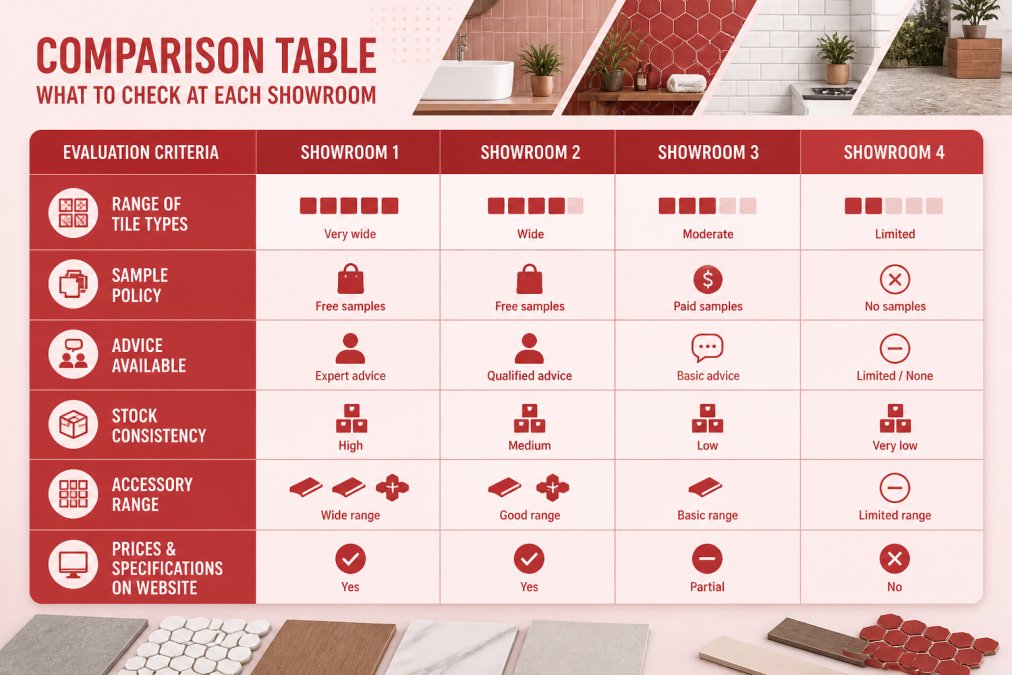
Comparison Table: What to Check at Each Showroom
| What to Check | Why It Matters | What to Look For |
|---|---|---|
| Range on display | You cannot judge a tile you cannot see | Floor, wall, outdoor and mosaic types shown together |
| Sample policy | Samples prevent expensive mistakes | Whether you can take a tile home before ordering |
| Advice quality | Suitability depends on the room and use | Staff who ask where the tile is going |
| Stock consistency | Running short mid-project stops work | Whether quantities and batch information are confirmed |
| Accessories | Adhesive, spacers and trims must match | A full range on site, not just tiles |
| Published specs | Size, finish and rating need checking | Details listed on the current product page |
Use this as a checklist rather than a scorecard. A showroom can be strong on range and weak on advice, or the reverse.
Take a photo of your existing floor, a cabinet door or a paint swatch to the showroom. Colour matching against a real sample beats matching against memory every time.
How to Choose Tiles for a Renovation
Start with the room and how it is used, then work backwards to material, size and finish. Most renovation mistakes trace back to picking a look before checking whether the tile suits the space.
Match the Tile to the Room and the Traffic
A bathroom floor and a hallway floor face different conditions. Bathroom floors deal with water and bare feet. Hallways deal with constant foot traffic and grit. Outdoor areas deal with sun, rain and temperature swings.
Ask three questions before you fall for a tile:
- Where is it going, and is it wet, dry or exposed?
- How much foot traffic will it take?
- Does it need to match an adjoining room?
For wet areas and outdoor spaces, suitability depends on the specific product, the location and the applicable requirements. There is no universal answer, so check the manufacturer’s information for the tile you are considering and speak to a qualified professional about your situation.
Finish, Format and Grout Lines
Finish is the surface: gloss, matt, textured or polished. Format is the size and shape. Grout lines are the joints between tiles.
A larger format means fewer grout lines and a cleaner look, but it needs a flatter substrate and more cutting. A smaller format suits curved walls and intricate areas. Grout width affects both appearance and how much movement the floor can accommodate.
What most guides miss is that grout colour changes the whole floor. A light grout on a dark tile creates a grid. A matching grout makes the tiles read as one surface.
Porcelain Tiles vs Natural Stone
Porcelain tiles and natural stone are different products, even when they look similar. Porcelain is manufactured to a consistent size, colour and finish. Natural stone is quarried, so every piece varies in shade, veining and thickness.
That difference drives everything else: sealing, maintenance, cutting and how the finished floor ages. A porcelain tile printed to look like travertine is still porcelain. It will not develop the patina a real travertine floor does, and it will not need the same care.
Natural stone suits projects where variation is the point. Porcelain suits projects where consistency and simpler maintenance matter more. Neither is better in every case, and the right answer depends on the room, the budget and how much upkeep you want.
Standards Australia guidance on building and construction standards
Questions to Ask When Buying Tiles
Ask these before you pay, not after delivery:
- Is this tile suitable for the room I am tiling?
- Can I take a sample home to check it in my own light?
- What is the shade variation between boxes?
- How much should I order for cuts and breakages?
- What adhesive, grout and trim does this tile need?
- Are the specifications and current price listed on the product page?
Ordering the exact quantity you measured, with no allowance for cuts, is the most common renovation setback. If you run short and the batch has changed, the replacement tiles may not match.
Using a Tile Quantity Calculator Before You Order
A tile quantity calculator works out how many tiles you need from your area and tile size, then adds an allowance. The allowance is the part people get wrong, because it depends on your layout, the number of cuts and how complex the room is.
For a simple, square room with few cuts, a smaller allowance may be enough. For a room with lots of corners, diagonal layouts or pattern matching, you need more. There is no universal percentage.
Worked Example: A Small Bathroom Floor
Take a bathroom floor measuring 2.4 m by 1.8 m.
- Area: 2.4 x 1.8 = 4.32 m²
- Tile size: 300 x 300 mm, which is 0.09 m² per tile
- Tiles needed: 4.32 ÷ 0.09 = 48 tiles
- Add an allowance for cuts and breakages, for example 10%: 48 x 1.1 = 53 tiles
That 10% is an assumption for this example only. A room with more cuts, a diagonal layout or a pattern that needs matching will need a larger allowance. Confirm the final figure with your tiler before ordering, and check current product pages for sizes and availability.
Seeing Tiles in Person at a Campbelltown Showroom
The most reliable way to choose a tile is to stand in front of it. Screens vary, lighting varies, and a tile that looks right on a phone can look wrong on a wall.
Our showroom carries floor, wall, bathroom, outdoor, subway and mosaic tiles, pool glass mosaics, porcelain pavers, travertine, adhesives and tiling accessories. You can browse online first, then visit to compare samples side by side and ask about suitability for your project.
Prices, specifications, availability and delivery terms change, so check the current product pages or ask us in person. If you are weighing up a tile showroom in Campbelltown for a renovation, bring your measurements and your questions.
Australian Building Codes Board on building regulation and compliance
Frequently Asked Questions
What should I look for in a tile showroom?
Look at the breadth of the range, whether floor, wall, outdoor, subway and mosaic tiles are all on display, and whether accessories such as adhesives and trims are stocked alongside them. Check the sample policy, how consistent stock is likely to be if you need more later, and whether staff can explain the difference between porcelain and ceramic or natural stone. A showroom that lets you take a sample home and view it under your own lighting gives you a far better idea of how the tile will look in your space.
Is it better to choose tiles in person or online?
Online browsing is useful for narrowing down styles and comparing ranges, but colour, texture and finish read very differently on a screen. Viewing tiles in person under showroom lighting, then taking a sample home to check against your cabinetry, paint and existing flooring, reduces the risk of a mismatch. Many buyers shortlist online and confirm in person. Check the current product pages for specifications, and confirm availability before committing to a large order.
What is the difference between porcelain tiles and natural stone?
Porcelain tiles are manufactured to a consistent size, colour and finish, and many are designed to imitate stone. Natural stone such as travertine is quarried, so each piece varies in tone, veining and porosity, and typically needs sealing and more careful maintenance. Porcelain is generally the more predictable choice for busy floors and wet areas, while natural stone suits buyers who want genuine variation. Suitability depends on the product, the location and the applicable requirements, so confirm specifications and speak to a qualified professional.
How many tiles should I order for a renovation?
Measure the area in square metres, then add a waste allowance for cuts, breakages and future repairs. The allowance depends on your layout and project, not a fixed rule: a simple square room with few cuts needs less than a diagonal or herringbone pattern with many. For example, a 4 m² bathroom floor laid straight might need around 10 per cent extra, while a diagonal layout could need closer to 15 per cent. Confirm quantities with your tiler, and check current product pages for coverage per box.
Renovation budgets stretch further when the tile choice is right the first time. Bargain Factory Tile Outlet offers a 1,000 m² Campbelltown showroom, factory-direct pricing and a full range of tiles and tiling accessories, with staff who will talk through your project before you buy. Get directions to the showroom and bring your plans.