Last Updated: October 9, 2026
How Many Tiles Do I Need? Start With Two Numbers
To work out how many tiles do I need, you only need two numbers: the area you’re covering in square metres, and the area each tile covers. Divide one by the other, add a wastage allowance, and round up to full boxes.
That’s the whole method. Everything else is detail.
This guide from Bargain Factory Tile Outlet walks through measuring rooms, converting tile sizes, a full worked example, and how much extra to order. We sell tiles every week to homeowners and trades, and the same mistakes come up again and again. The biggest one is ordering exactly the calculated amount, with nothing spare.
Here’s the thing nobody tells you: the maths is easy. Getting the measurement right is the hard part.
Your tile count comes from area divided by tile coverage, plus a wastage allowance. Get the measurement wrong and every number after it is wrong too.
How to Measure a Room for Tiling
Measure the length and width of the floor at its widest points, multiply them together, and you have your square metres. Measure in metres, not millimetres, so the numbers stay manageable.
A retractable tape and a notepad are all you need. Measure wall to wall, skirting to skirting.
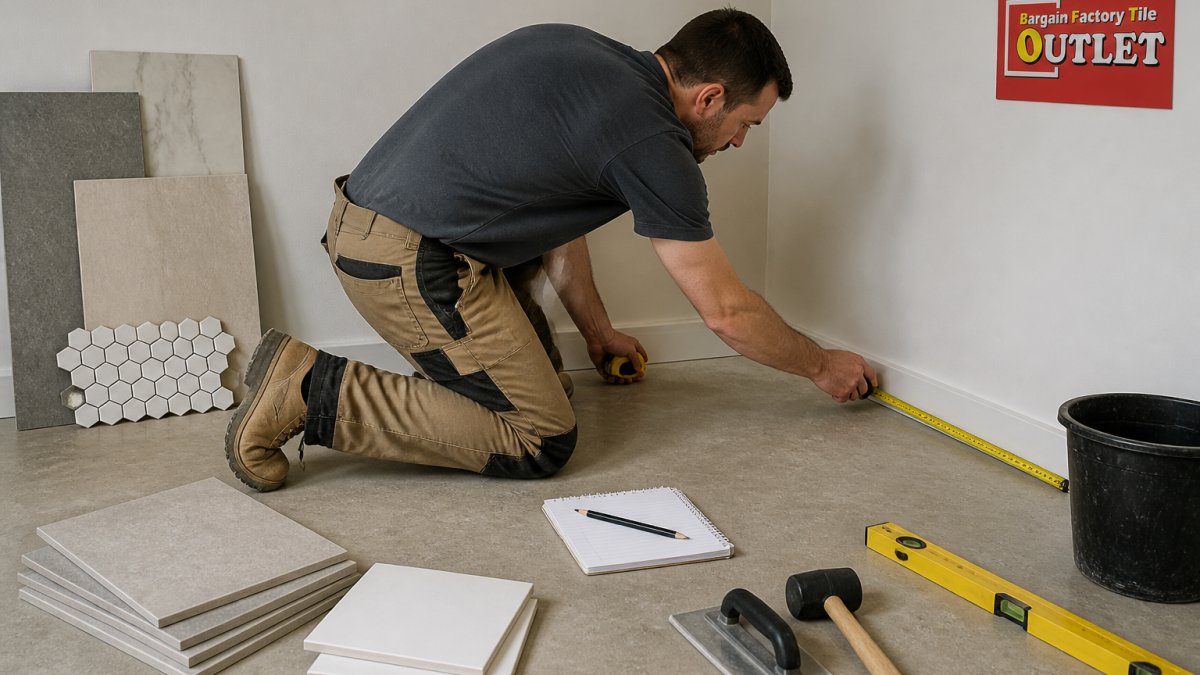
A few habits that save grief later:
- Measure at both ends of each wall, not just one. Rooms are rarely perfectly square.
- Write down the larger of the two figures for each direction.
- Note doorways and any fixed cabinetry you won’t tile under.
- Measure in metres and centimetres, then convert to metres.
Measuring an L-shaped room or one with an alcove
Split the room into rectangles, work out each one, then add them together. An L-shaped room is two rectangles. A room with an alcove is a main rectangle plus a small one.
Sketch it on paper first. Label each rectangle A, B, C. It takes two minutes and stops you double-counting a section.
Measuring a wall for a splashback or bathroom
For a splashback, measure the width of the worktop run and the height you want the tiles to reach. Multiply those two figures for the area.
For a bathroom wall, measure the full width and the height from floor to ceiling, then subtract the areas you won’t tile, such as a window or a large mirror. Splashbacks and half-height walls are usually the easiest places to underestimate, because it’s tempting to measure only the obvious flat section.
Working Out Tiles per Square Metre
Tiles per square metre tells you how many tiles fill one square metre. It depends entirely on tile size, and it’s the number that converts your room area into a tile count.
Here’s the conversion for common sizes:
| Tile size | Tiles per m² | Coverage per tile |
|---|---|---|
| 300 x 300 mm | 11.1 | 0.09 m² |
| 300 x 600 mm | 5.6 | 0.18 m² |
| 450 x 450 mm | 4.9 | 0.2025 m² |
| 600 x 600 mm | 2.8 | 0.36 m² |
| 600 x 1200 mm | 1.4 | 0.72 m² |
| 200 x 100 mm subway | 50 | 0.02 m² |
To check any size yourself: multiply the tile’s length by its width in metres, then divide 1 by that result. A 600 x 600 mm tile is 0.6 x 0.6, which is 0.36 m². One divided by 0.36 is 2.8 tiles per square metre.
Common tile sizes and what they mean for your count
Bigger tiles mean fewer tiles and fewer grout lines. Smaller tiles mean more pieces to lay and more cuts around edges.
There’s a trade-off most guides skip. Large-format tiles look clean and modern, but they need a flatter substrate and more care with cutting. Small mosaics are forgiving on uneven walls but slow to install. Neither is better. It depends on the room and who’s laying them. Choosing the right tile material becomes even more critical when considering the structural integrity required for installing solar panels on your roof.
Buy your adhesive and spacers for the tile size you’ve chosen, not the size you originally planned. Large-format tiles need a different adhesive bed to small ceramics, and swapping mid-project is a common and expensive mistake.
A Worked Example: Tiling a 3 m x 2 m Bathroom Floor
Say you’re tiling a bathroom floor that measures 3 metres by 2 metres, using 300 x 300 mm tiles.
Step 1: Work out the floor area.
3 m x 2 m = 6 m².
Step 2: Find tiles per square metre.
A 300 x 300 mm tile covers 0.09 m². So 6 ÷ 0.09 = 66.7 tiles.
Step 3: Add wastage.
For a straight-lay pattern in a simple rectangular room, add 10%. That’s 66.7 x 1.10 = 73.4 tiles.
Step 4: Round up to full boxes.
If the tiles come 11 per box, you need 7 boxes, which is 77 tiles.
That’s a spare 3.6 tiles above your allowance. Keep them. They’re your insurance against a cracked tile or a cut that goes wrong.
Don’t subtract the toilet or vanity footprint from your area. You’ll tile around them anyway, and the offcuts are rarely reusable. Subtracting them is how people end up short.
Setting a Sensible Tile Wastage Allowance
There’s no universal wastage figure. It depends on your layout, tile size and pattern, so treat any single number as a starting point rather than a rule.
What pushes wastage up:
- Diagonal or herringbone layouts. More cuts, more offcuts.
- Small tiles. More pieces means more edges to trim.
- Busy rooms. Toilets, vanities and doorways create awkward cuts.
- Large-format tiles. A single miscut wastes a big area.
- Patterned tiles. You may need to align a pattern across a cut.
What keeps it lower:
- A plain rectangular room with a straight lay.
- Tiles that can be rotated to use offcuts.
- Ordering from a single batch, so shades match.
As a rough guide, straight lays in simple rooms sit at the lower end, and diagonal or patterned layouts sit higher. Ask your installer what suits your specific room before you order.
When a Tile Calculator Helps and When It Misleads
A tile calculator is useful for the arithmetic, and unreliable for everything else. It will divide your area by tile coverage and add an allowance. It won’t know your room is out of square.
Use one to check your own maths. Don’t use one instead of measuring.
Where calculators go wrong:
- You enter the wrong tile size, or mix up millimetres and metres.
- The room isn’t a neat rectangle, and the calculator assumes it is.
- It applies a generic wastage figure that doesn’t match your layout.
- It doesn’t account for tiles you’ll cut around fixtures.
The fix is simple. Measure by hand, calculate by hand, then use a calculator to confirm. If the two figures disagree, trust the hand measurement and find the error.
Checking Your Tile Order Before You Buy
Before you commit, confirm three things: the total area including wastage, that all tiles come from the same batch, and that the supplier has enough to cover you if you need more.
Batch numbers matter more than people realise. Tiles from different production runs can vary slightly in shade and size, and that variation shows up once they’re laid. It’s advisable to check that the batch code on every box matches.
A short pre-order checklist:
- Room measured at both ends of each wall
- Area calculated in square metres
- Tiles per m² confirmed for your chosen size
- Wastage allowance added for your layout
- Total rounded up to full boxes
- A few spare tiles set aside for future repairs
One more note on materials. If you’re weighing up natural stone against a porcelain look-alike, they behave differently. Travertine and other natural stones vary in tone and porosity and need sealing, while porcelain imitations are uniform and lower maintenance. That choice affects your wastage too, because natural stone often needs more sorting and cutting around variation.
You can browse our range online and check current specifications on each product page. Our Campbelltown showroom is the place to see tiles in person, compare finishes and ask about quantities for your room.
Frequently Asked Questions
How do I calculate how many tiles I need?
Measure the length and width of the surface in metres, then multiply them to get the area in square metres. Divide that area by the area of one tile, which you get by multiplying the tile’s length by its width in metres. Add a wastage allowance for cuts, then round up to the nearest whole tile and check the number against the boxes the product is sold in.
How much extra tile should I allow for waste?
There is no single figure that suits every job, because wastage depends on the layout, the tile size, the number of cuts and how many spare tiles you want to keep. Straight lays in a simple rectangular room need less than a diagonal or herringbone pattern, and large-format tiles usually waste more than small ones. Ask your tiler what suits your specific layout rather than applying a blanket percentage.
Does tile size affect how many tiles I need?
It does. A larger tile covers more area, so you need fewer pieces for the same floor, but bigger tiles usually generate more offcuts around edges and obstacles. Smaller tiles mean more pieces and more grout lines, which slows installation. The total area stays the same either way, so the tile size changes the count and the waste, not the square metres you are covering.
Should I buy extra tiles for cuts and breakages?
Yes, keeping a few spares is worth it. Tiles can chip during cutting, and having matching tiles on hand later is useful if one cracks or you need to repair a small area. Keep the spares from the same batch, because dye lots can vary between production runs. Store them somewhere dry and flat so they stay usable.
Getting the measurement right is the part that decides whether your project runs smoothly or stalls halfway through. If you’d rather check your numbers before ordering, bring your room dimensions to Bargain Factory Tile Outlet. Our team can help you work through tile sizes, wastage for your layout, and what’s currently in stock, and you can see the tiles themselves in our 1,000 m² Campbelltown showroom. Get directions and visit us at 20A Blaxland Road, Campbelltown.